Off Grid Living – How to Build a Bathroom Sink that Repurposes
Grey Water to Flush Toilets for an Off Grid Home, Cabin or Shed
Click on the photo to see more pictures:
How to Install a Sink that Repurposes Grey Water to Flush Toilets for Off Grid Homes, Cabins or Sheds
Off Grid Water Conservation Toilets that Use Water Twice
For most off grid homes, cabins and sheds, every single drop of water counts. These grey water toilers are cool because they capture water used in the sink and store it in a toilet bowl and then use it to flush so that water can be used twice.
Please join our Off Grid Living Discussion Group on Facebook
Off Grid Living Bathroom Storage Ideas
for Off Grid Homes, Cabins and Sheds
Click on the photo to see more pictures:
Off Grid Living Bathroom Storage Ideas for an Off Grid Homes, Cabins and Sheds
Decorating Ideas for Off Grid Bathrooms
One of the most important rooms is an #OffGridHome‘s #Bathroom. Making every single inch of space count is even more important given is small size compared to other rooms in the house or cabin.
But thinking smart and planning well before building an off the grid bathroom can make every inch count.
Please join our Off Grid Living Discussion Group on Facebook
The Benefits of Using Passive Solar Heating and Wood Stove Water Heating Jackets to Heat Water for an Off Grid Shed, Cabin or Home
Click on the photo to see more pictures:
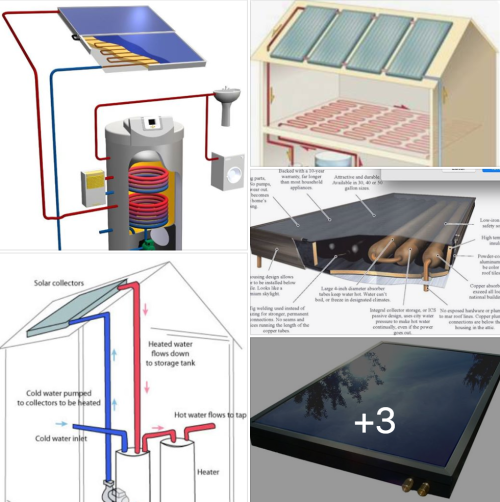
How to Use Passive Solar Collectors to Product Free Hot Water for Off Grid Properties
Various Types of Solar Hot Water Heaters to Heat Water for Off Grid Homes
United States – There are many options for solar water heaters that range from inexpensive home-made jobs to high-end state of the art commercial models.
If you switch to a solar water heating system, your use of electricity or propane will drop significantly; that number will approach zero rapidly if your backup heating system is a wood stove or firebox with a water jacket rather than occasional use utility electricity.
The home-made options are typically not suited for use during times of the year when temperatures dip below freezing. You would need to winterized them before any threat of fall or winter weather arrives. There are probably hundreds of variations that may be found on the internet. They range from coils of black plastic pipe on one’s roof to coils of copper inside a box with outer glass cover (creating a greenhouse effect).
Some of these utilize a DC electric circulating pump. It pushes the heated water into a storage tank and bring fresh cool water into the heater. This pump may be activated by a switch that is temperature controlled. But some are directly connected to a solar panel and only run when the sun is shining (precisely the same times that the water is being heated and needs to be circulated).
Evacuated Tube Solar Hot Water Heaters
Evacuated tube models are composed of numerous rows of glass tubes with another smaller tube inside each of the larger tubes. A vacuum is pulled between each of the two tubes which greatly lessens the loss of heat to outside weather. Water or an antifreeze solution is then circulated through the inner tubes.
The advantages of evacuated tubes lie in greater efficiency and less heat lost. So they work quite well even during surprisingly cool temperatures. However they are somewhat fragile and may not be as suited to areas with a great amount of snow and ice due to the potential for breakage from buildup.
Flat Panel Solar Hot Water Heaters
These heaters look much like solar electric panels but contain tiny water passages which enable a great amount of surface area to come in contact with the heat from the sun. While not as efficient as evacuated tubes, flat panels still work very well and are certainly more rugged when faced with heavy snow and icy conditions.
Typically an antifreeze solution is circulated through the tubes or panels and the hot fluid is routed inside to a heat exchanger which transfers the heat of the fluid to the home’s hot water. There are some varieties of evacuated tube heaters that are called drain down systems, which do not require the use of antifreeze because the water drains away from exposed areas once the water cools off.
Thermo-Siphon Solar Hot Water Heaters
It is possible to set up a solar water heating system that doesn’t require an electric circulating pump. This would be called a thermo-siphon system, operating on the principle that heat rises.
This was the type of system we planned to install for our cabin in the summertime. The disadvantages would be the amount of work involved in installation, significant cost of commercial systems, and reliance on an electric circulating pump (unless it is set up as a thermo-siphon system).
Off Grid Living: Solar Powered Lighting
Systems for Off Grid Cabins and Sheds
Click on the photo to see more pictures:
Solar Powered Lighting Systems for Off Grid Cabins and Sheds
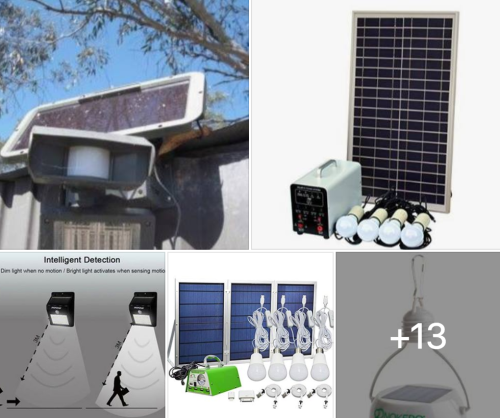
How to Install Off Grid Solar-Powered Lights
One of the first things you’ll learn when camping or off grid living is that without electricity, it gets dark quickly.
But solar power is a great way to provide a wide variety of lighting and security systems that will let see what is making that big bumping sound in the backyard at 2:00 am in the morning.
How Off Grid Solar Lights Work
Solar spotlights are powered by photovoltaic cells, which convert sunlight to electricity on the atomic level. Each cell contains a thin, flat semiconductor panel with a positive charge on one side and negative on the other. Sunlight causes the semiconductor’s atoms to blow apart, releasing electrons; the electrons are recaptured as electric current between the positive and negative charges. The electricity then travels through a cable to power the spotlight. Solar energy is also stored in the interior battery for use at night or on cloudy days.
Uses for Off Grid Solar Security Lights
Solar spotlights are particularly useful in illuminating outdoor spaces where traditional extension cords or bundles of wiring aren’t practical, such as in formal gardens, large open lawns or residential entrances. Newer models offer light emitting diodes (LEDs), which illuminate more effectively and efficiently than old-fashioned incandescent bulbs. Whether you choose to light a wide area from above or train the beam from ground level on an individual object, such as garden statuary, you can easily install individual spotlights without hiring a professional contractor.
Best Places to Install Off Grid Solar Lights
The foremost concern with installing solar spotlights is ensuring that enough sunlight reaches the photovoltaic cell. Spotlights today usually feature a long power cable between the cell and the actual light, so you can place the cell in a sunny spot that receives about eight hours of light a day, and position the spotlight where you want it.
For ground-level lighting, stake the cell in the ground so the cell faces the brightest sun, and then stake the light in the ground a few feet away from the object you wish to illuminate. Train the beam upward to focus on the object.
Mounting solar spotlights over entrances, garage doors or decks involves screwing the light’s baseplate into the vertical wall or post over the area you want to brighten, then angling the light’s beam downwards. With these types, the solar cell may be attached to the light’s hood or via a power cable; in both cases, the cell still needs to receive sufficient sunlight for operation.
The video above presents a comprehensive buying guide for wood stoves – a primer on exactly what you’ll need to know before buying a wood stove for your off grid shed, cabin, container home, earthship, steel building, tent, tiny house, yurt and/or any other type of off home.
Top Stove Buying Decision Include:
Steel vs. Cast Iron Cost
Stove Output (BTU vs. Size)
Firebox size
Efficiency Catalytic vs. Non-Catalytic
Flue (Interior and Exterior)
Hearth Protection
Wood Storage Ash Pan
Aesthetics Maintenance
Checklist of Items to Consider when Buying a Wood Stove:
It may be summer now, but winter is coming and its going to be a cold one. Here are some simple considerations to think about when buying the right wood stove for your shed, cabin or other type of off grid home.
1. Decide Between a Fireplace and a Wood Burning Stove
There are two main types of wood stoves. A fireplace, which is usually imbedded into a wall and a free standing stove, which sits in an open air space somewhere in a room. Fireplaces are usually open and waste a lot of energy and are prone to fires outside the fireplace as popping wood can send sparks flying out onto the room’s floor.
Free standing stoves are usually better because they can control the burn rate of your wood. They are much safer because they keep the fire enclosed inside a door. And, they radiant heat on a 360 degree basis, which is really important in very cold climates. When combined with masonry stone walls, they will heat up stone that will do a great job of efficiently heating up your home and keeping it toasty warm.
2. How Large Should Your Heat Source Be?
Picking the right sized wood stove for your living space is critical. A number of wood stoves for sale come with huge fireboxes, 3, 4, and sometimes even 5 cubic feet. But with modern insulation and the supplementary heat that most houses have now, these are usually overkill. A home between 2,000 and 3,000 square feet usually calls for a wood stove with a firebox between 2 and 2.5 cubic feet. If you’re heating a smaller space, like a garage or a cabin, you might want to try looking for even smaller wood burning stoves – 1 to 1.5 cubic feet.
Higher efficiency means less money spent on wood, less work chopping and hauling wood, and a product that is better for the environment. Older wood stoves tend to be inefficient and waste wood and many companies don’t publish their efficiencies as a result. Look for wood stoves for sale that have EPA listed efficiencies of 70% or above to get the most bang for your buck. Some new stoves, like MF Fire’s Catalyst, also come with smart thermostat technology that helps to cut down on overheating, giving a real world efficiency boost of 20 to 25%. Buying a wood stove from MF Fire means less chopping, less stacking, and fewer trips to the wood pile during winter storms.
4. Clean Air and the New EPA Regulations
Gone are the days of smoke belching potbelly stoves. New clean air standards have set a high bar, restricting wood stove smoke emissions to only 2.0 grams/hour by January 2020, making nearly 85% of currently available wood stove illegal to sell. But some manufacturers are still trying to squeeze out their old units before the deadline. To get the cleanest and most efficient burn, look for wood burning stoves for sale with EPA listed emissions below 2.0 g/hr.
5. Catalytic or Non-Catalytic Fireboxes
When they were first introduced in the 80’s catalytic stoves, or wood burning stoves that use a catalytic combustor to reduce emissions, got a bad reputation. These initial poorly designed wood burning stoves were impossible to get started and used catalytic combustors that fouled and went bad after only a few seasons. New catalytic stoves don’t have those problems.
Most catalytic wood stoves for sale today are significantly cleaner and more efficient than their non-catalytic counterparts and those catalytic combustors can last for 10 years or more. When they do need to be replaced, the replacements generally cost less than $100. Some catalytic stoves can be harder to start, but buying a wood stove with new smart stove technology like automatic igniters or MF Fire’s TurboStart technology makes them easier to start than ever.
6. Smart Wood Burning Stoves
Technology is in everything nowadays: phones, cars, even refrigerators. Modern wood stoves are no exception. Some new wood stoves include features that make it easier to start, remotely control your burn, and even to protect your family from chimney fires. Buying a wood stove with these modern features help those of us who are getting up in years to do a little less work and have a lot more peace of mind. While smart wood stoves frequently cost a bit more, buying a wood stove with the added features are usually more than worth it.
7. Gathering and Stacking Wood
Acquiring, stacking and moving wood will become a part of your life. I personally embrace these as part of my choice to live in a cold climate, and I feel like the added effort is good for both myself and the environment — but it’s certainly not for everyone.
Setting Up an Easy to Build Rainwater Harvesting System with a Tin Roof, Rain Gutters, Screens, Chlorine Tablets, Storage Tanks and an Activated Carbon Filter to Ensure Safe, Clean Drinking Water
Canada – Almost twenty years ago, I set up this rainwater collection system out in the woods. Using about three hundred square feet of metal roofing to catch the rainwater, the water is run through a very coarse filter as it exits the gutter.
Before flowing in to the 2,000 gallon storage tank, the water passes through a much finer filter and is chlorinated at the same time, using a slow dissolving chlorine puck normally used in pools and spas.
Thus the collected water is cleansed of debris and other nasty stuff before it enters the storage tank. This, I think is key to successful acquisition and storage of rainwater. If the water is not clean before entering storage you are making extra work for yourself “downstream”, assuming you intend to drink it. I have never had to clean the inside of the tank (which can be a dangerous job) or been afraid to drink the water after final treatment and filtration.
Of note, is the fact that the tank is pigmented (green in this case), which helps prevent sunlight activating growth of any kind in the precious water. White or clear tanks are not so great for blocking the harmful effects of sunlight. During warm weather I monitor the chlorine content of the stored water.
With regards to chlorination of water, ScientificAmerican.com states, “Chlorine effectively kills a large variety of microbial water-borne pathogens, including those that can cause typhoid fever, dysentery, cholera and Legionnaires’ disease. Chlorine is widely credited with virtually eliminating outbreaks of water-borne disease in the United States and other developed countries.”
In addition, Life Magazine recently cited the filtration of drinking water and use of chlorine as “Probably the most significant public health advance of the millennium.”
It only takes a cupful of household bleach to effectively “shock” the water free of most pathogens. I usually do this on departure from the cabin and the residual chlorine then has time to dissipate prior to our return. In case there is any residual chlorine in the supply, I again filter the water before use, using an activated charcoal cartridge in my Rainfresh household water filter.
The result is a reliable source of fresh clean drinking water that literally falls out of the sky! No need to drill a well or construct unnecessarily complicated systems, electrical or otherwise.
The whole system runs on gravity; the storage tank is approximately 100′ higher than the cabin.
For every foot of elevation, water pressure below rises by .43 pounds per square inch, resulting in about 43 psi at the cabin level. The pressure is entirely sufficient to run the filtration system, a propane fired demand hot water heater and a hosepipe – all the water amenities of living in town.
Of course, with even a simple system such as this, some degree of maintenance is required. After all, you are running a small utility. Perhaps the biggest concern comes during the winter months, which in our part of the northern hemisphere can become freezing cold at times, potentially causing burst pipes, valves and filter bowls, if they are not properly drained in the fall.
In the woods, tree debris falls on the roof and despite best efforts, gutters always clog too quickly. Water filters have to be exchanged once in a while and attention has to be paid to chlorination. However, basic maintenance is a small price to pay for such a life sustaining benefit.
# # #
More Articles on Rainwater Harvesting for Off Grid Homes:
What it means to live with our new off grid 5.2-kW solar
power array and how we manage power living off the grid.
North Carolina – Guildbrook Farm is an off grid, modern homestead located in the foothills of Appalachia. We take you along on our journey to become more self reliant by growing an organic garden, raising heritage breed chickens and pigs, improve our skills in canning and food preservation, building off the grid renewable energy systems, prepping for events such as natural disasters, and learning old time skills. Join us as we build an off-grid cabin and homestead from raw land while remaining debt-free. Follow our successes and failures as we learn to live a more simple, sustainable lifestyle.
Read more articles about Solar for Off Grid Homes:
Searching for Information on How to Start Living Off Grid in Tennessee? Our “Living Off Grid Newsletter” Provides Everything You Need to Research Before Building an Off Grid Cabin in Tennessee
Have questions about what it will take to live off the grid in Tennessee? Join our Tennessee Off Grid Living Group on Facebook to read, see and learn more about the Off Grid Living lifestyle!




 Off Grid Living - Learning How to Live Off the Grid